Scalar Protomythological Forms
Postmodern Rationalist Musings
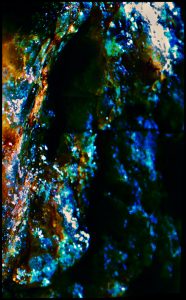
At the most broad definition, the perception of scalar Protomythological Forms happens when unusual shapes of curious objects are evinced through accidental, attenuated or focused attention. Perception focused on the environment may reveal a panorama or microcosm; Protomythological forms are scalar, which means they can be seen in a nebula or within the contents of a microscope slide. They are most easily seen in specific metamorphic rock material such as feldspars. They are seen in mountain scarp. They are not “errors” of perception. These forms are part of the landscape. Not just a rock surface, but a tree, a hedge, a stump, any edge one signifies may reveal a form. Attention to the surface edge, it’s shape and lighted characteristics, reveal highlights and shadows and elicits cognition, recognition, and perhaps a memory. The with which frequency forms are perceived would indicate an activity of memory, the recognition of form.
The forms provide meaning: A symbolic representation on rock, mirroring a reality of past eons. It is inextricably stretched in Time away from us, barely perceptible on the edge of the gargantuan 500 million year old crevasse spreading forth a star-crossed, immense and unimaginable opening in space: Time elongated and extended beyond human comprehension.
It is time for the re-apprehension of the past. With memory comes hope. The hope of a return springs eternal. But, what is it returning that Humans so Wish? We are amnesic. We cannot remember for what we wish.
Yet, hints may lay all about us. With recognition comes memory. The visible horizon of time, like a three-dimensional axis on edge, how to look down it, across the stupefying, utterly locked, echoing past, cyclically echoing. Modern Humans’ tiny fraction of time is illumined by the brackish and dim light of technology that cannot forge beams across the expanse of Time. Subjective memory reads, artificial memory counts, and we gather rungs in the ladder of history. We build a way into the timeline, climb into it, and look for tiny lights and bits of data to point us in the right direction. Physicists and geologists look for very small items, like quarks and zircons. All the attention to astronomy paid by the ancient Modern Humans provides ample evidence they were driven and compelled to track the tiny lights to the smallest minutia available. They were locating their place in the timeline. But, at this time, our way into the timeline is through technologically enhanced memory. Stepping into the timeline means stepping into the universe as a sphere around you. You are at the center. Your own private bell, cast it, dive into the field of cacophony. Perhaps shapes will resonate, cast a perceptible frequency into the data to awaken visual memory as a lifting fog reveals depth. As sound waves propagate, so do the visual, scalar forms of yore perpetuate through material’s temporal existence.