Pattern of Shear II
Rock Production
Protomythological forms are recognizable forms of objects and sentient entities which are preserved on rock as a written text. The observation of the forms reveals data. Information and data obtained by viewing the form are historical records and memories. The data may contain information about the time that the surface and the interior of the rock was created. Or, it may contain information older than the rock itself. Protomythological Forms on feldspar visible as patterns of shear are produced, in effect, by the controlled expulsion of lava through natural dykes and sills. Lagoons of flowed lava cool in a pegmatitic pool of feldspar, with quartz inclusions cooling at the end points of the flow and within the mass. The feldspar material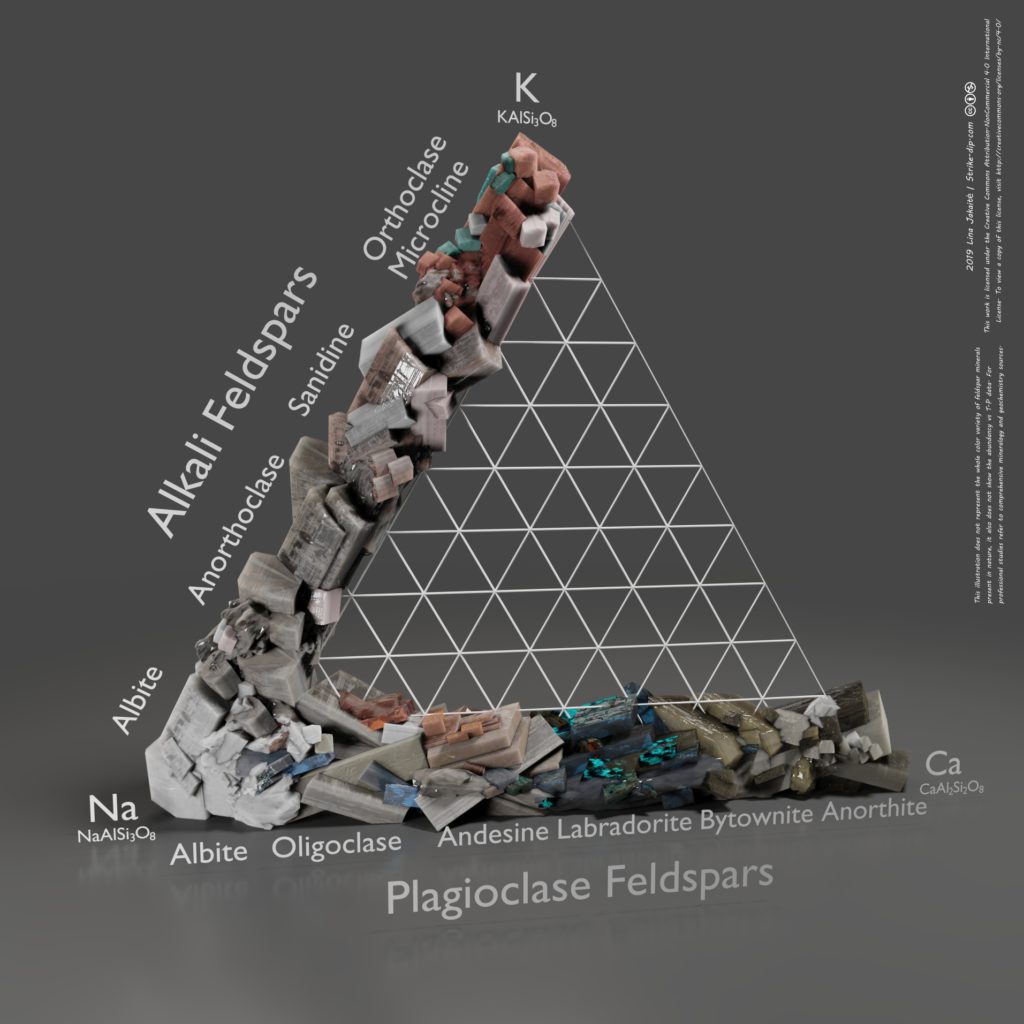 becomes molten and with a mixture of quartz hardens into a plagioclase rock, or cools and becomes the alkaline variety such as sandine or microcline or orthoclase. Extruded rock, shorn rock, at the base of a huge volcanic pyramidal mine/pumping station, a lava-fall if used would cool the rock, or else a large lake or retention pool would be used. And the rock would be naturally or artificially cleaved apart. It may stay in one place or it may be used to build walls and cities in any part of the world.
No Living Forms?
The substance we observe as rock is a data fragment. Feldspar is one of the most abundant materials on the surface of the Earth, and the Eath is covered in data. For hundreds of years now, geological science has been finding data in limestone and sedimentary rock. The data extracted from metamorphic and igneous rock is generally less revealing: Interesting clues such as chemical composition and relative age are important, but limited. Stuck inside this metamorphic and igneous rock, there were no obvious “life forms” which we could readily identify. Simply, our current scientific paradigm concerning what constitutes a “living life-form” is constrained. The study of rock in general is limited by it’s opacity. But maybe the rock is data-rich at its least opaque area: The Surface. Poured or belched out of a 2000 degree lava tube, the rock material in an elongated flow pattern, at its core and at its surface had to cool and form. Banks of large and small crystals materialized within the feldspar. Areas cooling faster than others create larger crystals. This materialization process, marked by the variable abundance of potassium or sodium or calcium, was manipulated by some electro-magnetic current which carried the means to create intelligible symbolic media. (Today we manipulate magnetic tape and foil to carry audio and video data.) This feldsparic rock carries a signature of the original builders. Their signature is their historical data. The data is visually available. Using light and shadow and color in a manner to create a form of near-holographic imagery, to enhance vision, we can view the beings and activities that were sentient, salient and abundant at that time.
And strange to us. Recognizable forms include animals and humanoids with legs, arms, heads, and torsos in specific positions, often standing or leaning with equipment or a dias or pedestal. Postures of sentient forms, facial or gestural expressions, convey both emotive and rational narrative structure and source material data. These forms may be the shadows on the surface of the wall in Plato’s cave. The shadows are important in discerning the forms. Lighting the translucent surface we can view the interior of an ancient world which portrays figments of historical data that contain analogies to human culture, and even the proto-mythological palate of emotions that could be available for viewing. The shadows contain data congruent with, as well as in contrast to, the light edges. Shadows construct alternate forms that complement the lighted colors, much like a figure-vase illusion, and its seamless transition from one to the other. The shadow forms and the colors are complementary, even if different. For example, the lighted portion may tell one story and the dark lit portion another version. These contrasting shapes define each other. Seeing the unified, scalar symbol this way provides many opportunities for narrative description.