
Pattern of Shear I
Here we are at the beginning of a journey: this rock is telling a story.
To begin, we simply have to wonder how the rock can produce intelligible data which current mortal Humans can rationally translate into culturally common themes. Civilizations across time, and civilizations of ancient magnitude may develop culturally common themes that we as Homo Sapiens can recognize. Recognition of thematic forms opens signification, or language, for expansion. And within this space, the visual data found on the rock surface reveals forms that provoke an analogy: a narrative. The narrative we can recover occurs prior to Modern Human existence (circa 195,000 BCE).
But, how much time prior to Modern Humans does the rock occur? How old is this Alkali Feldspar rock? Geological data suggest that the feldspar rock could be 500 million years old. Is that date accurate? The Plagioclase variety of feldspar as well as the Alkali Version of Feldspar, such as orthoclase, are igneous rocks. 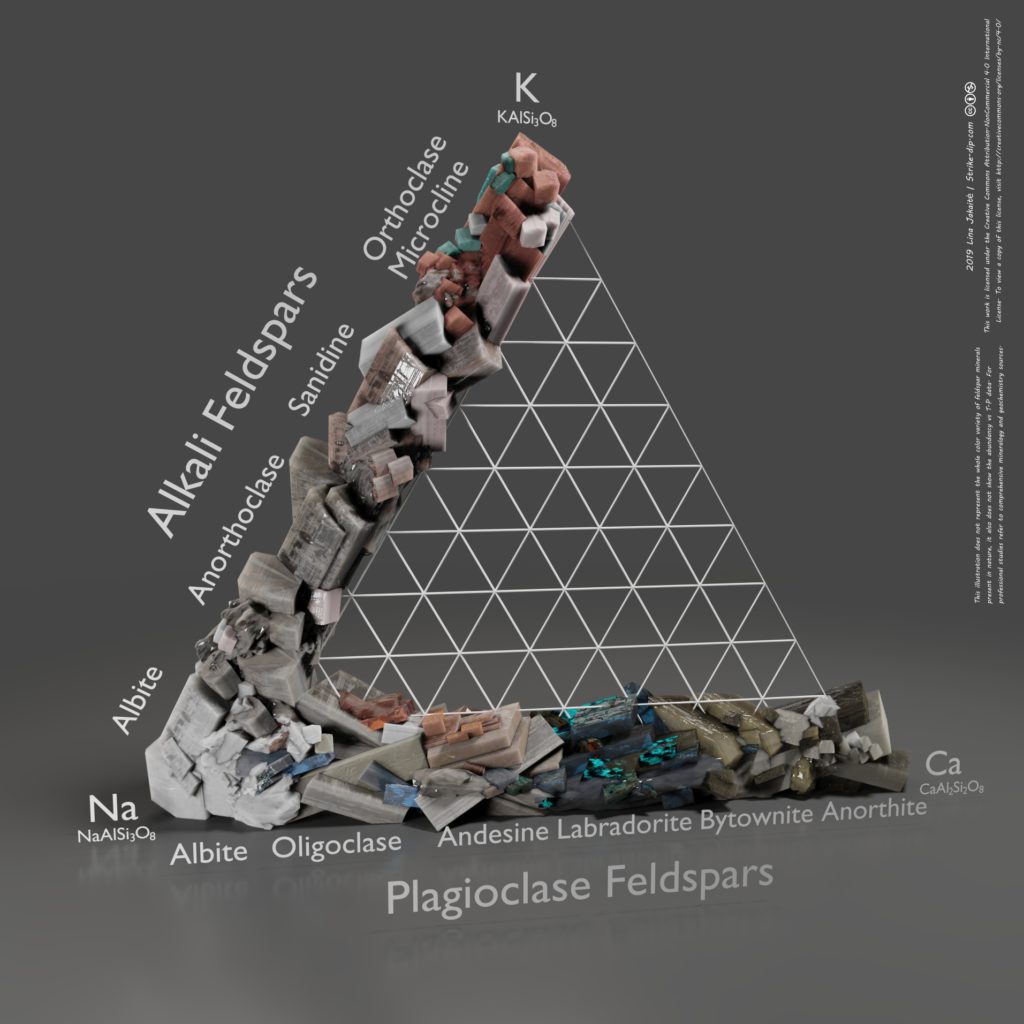 The enhanced images of the surface of the rocks were retrieved from orthoclase found in the eastern states of the United States. Volcanic and mountain building geological activity in that area occurred from over a billion years ago and during the Paleozoic period from 500 to 300 million years ago. These geological dates suggest that the plagioclase may be 500 million years old, being born at the time of high volcanism which helped form the Appalachian Mountains. Just as possible is the date of 250 million years old which is the latest time period geology records for volcanic activity in the Appalachian mountain area. Science tells us that five hundred million years ago marks the earliest eon well-organized, living material on the planet can be found. Five hundred million year-old fossil discoveries mark the rise of aquatic life in the Cambrian Explosion time period. But the rocks could be older than that, as volcanism was presumably present in the environment before the 500 million year old Cambrian Explosion. Dated to the Early Paleozoic and Pre-Cambrian period, with a typical chemical composition, (potassium, sodium, calcium,) and a normal hardness and luster, the feldsparic rocks still retain data, today. This data is visible. Humans can visually interact with it. Some of the image data will elide recognition. There are themes we are incapable of cogitating. But the visual data generates a narrative which is available as descriptions of the images. And that is the subject at hand: What are these forms that are visible on the surface of a rock?
Viewing Protomythological Forms
Protomythological Forms—What is it? Where does it come from? Protomythological Forms are visible. You can see them. For example, the side of a rock: A pattern of shear, breakage, or extrusion on the surface. At depth, a millimeter or less within the quartz, the reflected light interacts with the smoothed patina at the top of the surface. The light intersecting the crystalline structure of the surface and interior sub-surface enters your eye. Is it opening a three-dimensional depth in your visual field? How does perception of the hologram obtain in your brain? The light cast from the rock, reflected from the sun, is not an illusion. The light is teeming with data.